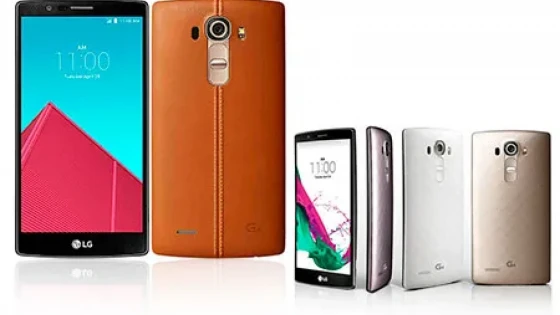
The Korean firm LG came out to kick the board of high-end smartphones with its LG G4 this April 29, putting its competitors with the same operating system (Android) and even the iPhone 6 in its two versions in trouble.
LG G4 emphasized several points highly sought after by users lately, its camera and the possibility of expanding its storage.
Its rear camera is the best! 16 Mp OIS 2.0, so far within the normal parameters, the novelty is the shutter aperture at F1.8, a feature that allows it to absorb up to 80% more light than the previous LG G3 and achieve quality images even in the poorly lit environments.
As I mentioned previously, the LG G4 maintains one of the features most appreciated by Android users. Its expansion slot for MicroSD cards of up to 128 GB, a factor that can be decisive in boosting sales. As you can see in the comparison table, together with the HTC One M9 they are the only ones that have this feature, on the contrary, their competitors no longer allow the storage capacity to be expanded.
The battery without a doubt is an advantage that it is removable in the LG G4, while the rest of its competitors opted for a non-removable internal battery. In the case of intense use of the devices and for those of us who are hyperactive for around 8 pm a day, it is essential to have an extra charged battery when returning home.
Its Quad HD IPS Quantum screen, apart from a generous size, a LG trend in its latest models, is the first of its kind to incorporate nano crystal technology (quantum dot), reflecting light with 20% more color, 25% more brightness and 50% more contrast than conventional Quad HD screens.
As far as aesthetics are concerned, two important points stand out:
- The back cover has a leather version handcrafted with six different colors, quite novel. It surely improves the grip significantly and in terms of aesthetics, it has a certain elegance, but greater care will have to be taken to avoid typical leather deterioration. Alternatively, it presents another version with ceramic material.
- The shape of the case has a slightly curved construction that differentiates it from the competition, inspired by the LG G Flex, and with an approximation to the Samsung Galaxy S6 Edge, giving it greater support against falls compared to other smartphones.
Smartphone comparison 2015
| Features | G4 | Xperia Z3 | Galaxy S6 | Galaxy S6 Edge | HTC One M9 | Iphone 6 | Iphone 6 Plus |
|---|---|---|---|---|---|---|---|
| Manufacturer | LG | Sony | Samsung | Samsung | HTC | Apple | Apple |
| Operating System | Android 5.1 | Android 5.0 | Android 5.0.2 | Android 5.0.2 | Android 5.0.2 | iOS 8.0 | iOS 8.0 |
| Touch | Touch | UX 4.0 | TouchWiz | TouchWiz | Sense 7 | Multi Touch | Multi Touch |
| Display | 5.5" QHD Quantum IPS LCD (2560x1440, 538ppi) | 5.2" QHD Quantum IPS LCD (1920x1080, 441ppi) | 5.1" QHD Super AMOLED (2560x1440, 577ppi) | 5.1" QHD Super AMOLED (2560x1440, 577ppi) | 5.0" FHD Super LCD 3 (1920x1080, 441ppi) | 4.7" Retina HD (1334x750, 326ppi) | 5.5" Retina HD (1920x1080, 401ppi) |
| Processor | 1.8 Ghz Snapdragon 808 (hexa-core) 64 bit | 2.5 Ghz Snapdragon 801 (hexa-core) 64 bit | 2.1 Ghz Exynos Quad + 1.5 Ghz Quad (octa-core), 64 bits | 2.1 Ghz Exynos Quad + 1.5 Ghz Quad (octa-core), 64 bit | 2.0 Ghz Snapdragon 810 (hexa-core) 64 bit | A8 APL1011 64-bit Coprocessor M8 | A8 APL1011 64-bit Coprocessor M8 |
| RAM | 3 Gb | 3 Gb | 3 Gb | 3 Gb | 3 Gb | 1 Gb (8 stands for 8Gb) | 2 Gb (16 stands for 16Gb) |
| Storage | 32 Gb + MicroSD Slot (Max 2 TB) | 16 Gb + MicroSD Slot (128 Gb) + 50 gb online | 32 Gb / 64 Gb / 128 Gb | 32 Gb / 64 Gb / 128 Gb | 32 Gb + MicroSD Slot (Max 2 TB) | 16 Gb / 64 Gb / 128 Gb | 16 Gb / 64 Gb / 128 Gb |
| Camera | Rear 16 Mp OIS 2.0 F/1.8 - Front 8 Mp | Rear 20.7 Mp OIS 2.0 F/1.9 - (4K Video - 3840 x 2160) - Front 2.2 Mp | Rear 16 Mp OIS 2.0 F/1.9 - Front 5 Mp | Rear 16 Mp OIS 2.0 F/1.9 - Front 5 Mp | Rear 20 Mp OIS 2.0 F/2.2 - Front 5 Mp | Rear 8 Mp iSight F/2.2 - Front 1.2 Mp | Rear 8 Mp iSight F/2.2 - Front 1.2 Mp |
| Battery | 3,000 mAh (removable) | 3,100 mAh (removable) | 2,550 mAh (integrated) | 2,600 mAh (integrated) | 2,840 mAh (integrated) | 1,810 mAh (integrated) | 2,915 mAh (integrated) |
| Networks | LTE, CDMA, GSM | LTE, CDMA, GSM | LTE, CDMA, GSM | LTE, CDMA, GSM | LTE, CDMA, GSM | LTE, CDMA, GSM | LTE, CDMA, GSM |
| High | 148.9 mm | 146.0 mm | 143.4 mm | 142.1 mm | 144.6 mm | 138.1 mm | 158.1 mm |
| Width | 76.1 mm | 72.0 mm | 70.5 mm | 70.1 mm | 69.7 mm | 67.0 mm | 77.8 mm |
| Thickness | 9.8 mm | 7.3 mm | 6.8 mm | 7.0 mm | 9.61 mm | 6.9 mm | 7.1 mm |
| Weight | 155 grs | 152 grs | 138 grs | 132 grs | 157 grs | 129 grs | 172 grs |
| Material and Colors | Ceramic: grey, white, gold. Leather: black, brown, red, light blue, beige and yellow | Aluminum and tempered glass. Black, white, bronze, lilac, green | White, black, gold and blue | White, black, gold and green | Dark Grey, Silver and Gold | Metal and Glass. Silver and Gold | Metal and Glass. Silver and Gold |
The negative point
Before such virtues of the LG G4, it is still not understood why they used a processor with such low performance compared to it. with his competitors. If LG can be justified in any way in such a decision, is it supposed to avoid excess heat, avoid lower battery consumption or lower costs and compete at the price level? No matter how many justifications the Korean company provided, there are already a couple of performance tests going around that completely disfavor it in this aspect.