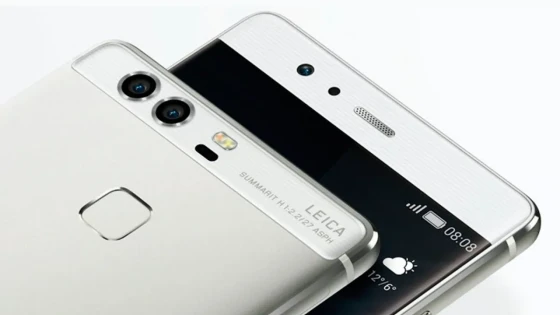
The German company Leica took one of its most important steps in the world of mobile photography, by certifying the cameras of the Huawei P9 and P9 Plus, undoubtedly the highlight of the new equipment.
Huawei promised that users will now be able to capture images in both vivid colors and black and white. Because? The main cameras of the P9 have 12 megapixels (F2.2), one is RGB (red, green and blue) and the other monochrome.
That is, one specializes in capturing color and the monochrome is designed not only for black and white images but also to capture more details thanks to the contrast levels it can achieve. For this, it has two light sensors that are 25% larger than those of the P8. In this way, according to the manufacturing company, it captures 90 percent more light than the Galaxy S7 and 270 percent more light than the iPhone 6S. "The two rear cameras of the P9 work together to allow users to create images with greater detail, depth and color. The P9 excels in low light conditions, because the dual camera design guarantees greater capture of light and details," the company promised. company.
Finally, the front camera which will have 8 megapixels.
It is not the only thing
Both versions differ in the size of the screen: 5.2 and 5.5 inches, with Full HD resolution (423 dots per inch; 401 in the case of the Plus model), 500 nits with 20 backlight LEDs. In addition, the screen is sensitive to pressure and the phone will come with 18 native applications that will take advantage of this feature.
The battery will be quite generous with its autonomy since it has about 3,000 mAh, 3 Mb of RAM for the P9 and 4 MB for the P9 Plus. The internal memory in both cases is 32 MB. Kirin 955 eight-core processor.
Without a doubt, this high-end device will be able to challenge other devices in the same segment, remember that Huawei has been the third largest smartphone seller in the world and threatens to give a tough fight to firms like Samsung and Apple.
Updated on: 12/04/2016 00:00:00
Source of Information: Infobae Tecno / ABC Tecnología