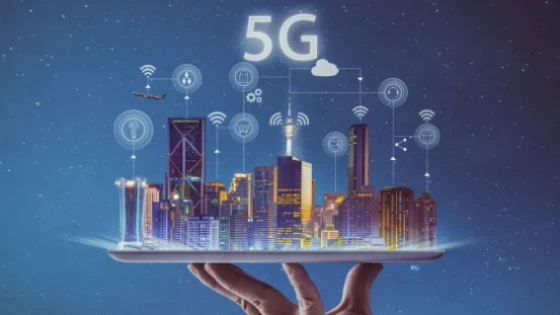
In the midst of the development of the 4G network in our country, we are already beginning to hear about the next technological leap in connectivity: 5G. Different advances and agreements among the international community already allow us to anticipate its advantages, although it is expected that this technology will only begin to be used in 2020.
Advantages
Higher speed
The future 5G network promises more speed than the current one, but to what extent that will happen is still not entirely clear. Tests have been carried out that exceed 10 Gbps, which exceeds almost 10,000 times the average speed of current 4G in Argentina. It should be noted that these were carried out under "laboratory" conditions and there are many factors that will affect that number once the networks are installed, from the selection of spectrum frequencies to the number of connected devices. In any case, although the jump from 3G to the technology used today fundamentally implied faster connections, that of 5G implies another series of advantages that can be considered even more important.
Lower latency
Latency is the delay between a request and a response within a network. For example, the one that appears when we press the play button (►) of an online video until that content begins to play, or between when we click on the link of a website and it begins to load. In 3G networks, this response time averages 120 milliseconds (ms) and the arrival of 4G has reduced that time by half or even less, but the leap of 5G promises to be much higher: a latency of 1 ms is estimated, which makes it practically imperceptible.
Perhaps it seems irrelevant, But for many new technologies this speed of communication is much more necessary than the ability to quickly download large volumes of data. For example, a smart car traveling at 100 km/h on a 4G network with a latency of 50 ms can travel up to 1.4 meters between being given the order to brake and reaching the vehicle. In a 5G network, that distance, which can be the difference between having an accident or avoiding one, is reduced to less than 3 cm.
The case of smart cars is not the only one: this type of precision would enable remote processes, such as remote surgical interventions, which are not feasible today, and would facilitate the operation of thousands of connected devices in the Internet of Things Ecosystem, which do not require high data upload and download speeds, but rather a network that guarantee instantaneity.
Density and energy consumption
Precisely the advance of 5G, hand in hand with the deployment of IPv6, points to the massive development of the Internet of Things. Not only for latency issues, but also because it guarantees enough space for thousands of devices to join the network simultaneously: 3G and 4G are very sensitive technologies to the number of mobile phones connected in the same area (a full football stadium, a recital), but 5G will have the capacity to support a density of up to 1,000 devices per m2, enabling, in addition to cell phones, a large number of sensors, wearables, cameras and IoT devices.
At the same time, the new network aims to be much more efficient than the current ones in terms of energy consumption. It is estimated that it will achieve 90% savings compared to 4G, also contributing to longer battery life of the equipment.
The progress so far
The international community is already working hard to have the 5G standard ready in the short term, that is, to establish the standards and specifications that everyone involved in the new technology must follow. In December 2017, 3GPP (3rd Generation Partnership Program), the organization in charge of agreeing on the characteristics of mobile communication, took a big step by officially announcing the first non-standalone 5G standard, designed to work on current LTE networks. The autonomous version, the one that allows 5G to be deployed on new networks, without having to use existing infrastructure, was confirmed in June of this year. Now that both "halves" of the standard are ready, developers, manufacturers and governments will be able to move more easily and in the same direction to make this technology a reality.
Updated on: 01/11/2018 00:00:00