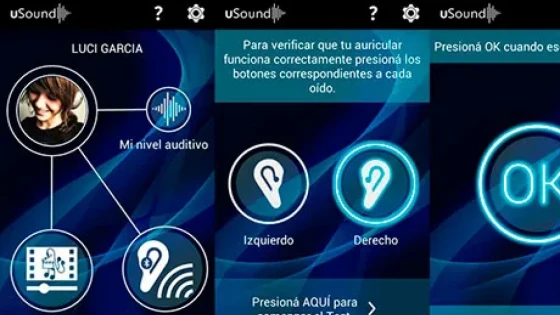
After more than two years of work and research between multiple disciplines and technical challenges, the Argentine application for hearing impaired uSound is now available for Android from the Google Play store. Developed by a group of students from Jujuy, this program takes advantage of the capabilities of a smartphone by transforming it into a powerful hearing aid for people with reduced hearing abilities.
"Only 1 in 40 hearing-impaired people can access the medical equipment necessary to alleviate their problems. With uSound we are able to emulate the benefits of an expensive hearing aid (which can cost between $500 and $2,000) with a smartphone and Bluetooth headphones or with cable," says Ezequiel Escobar, one of the co-founding members of uSound.
"The phone allows you to adjust the sound more appropriately, and also has an audiometry test that is complemented by observations made by a doctor," adds Escobar.
uSound is free to download and has a free 30-day license to try the application with all its functions. Then, it will have a cost ranging from $2.5 monthly to $30 annually. In turn, each download has a proportional free license that can be allocated to another person who cannot pay for the service.
"It is a one-for-one model: someone who can pay for the uSound license also gives the possibility of accessing the application to another user who does not have the necessary financial resources," explains Escobar.
"This donation model is not limited only to hearing-impaired patients, since anyone can purchase the application to donate the service to any user. of the world that requires uSound's services. To this end, the company is in negotiations to manage these license requests with the main medical centers and NGOs in the country and other regions of the world to be able to channel the scope of the application in the most appropriate and transparent way.
How does uSound work?
"We are convinced of this business model without losing our social value, with the uSound application accessible to everyone, but without ceasing to be profitable. We can give away the development, but we would not be able to sustain this initiative in the time"
After having participated in Microsoft's international Imagine Cup competition and after being selected as one of the start-ups selected by Wayra Argentina, uSound has a different profile from the rest of the ventures, with research and development work both in the technical area and in the health sector.
"In all the companies we invest in, we look for the meeting point between Telefóonica and the companies we invest in. But this is not always the case, we also look for technology ventures. that can grow and have the potential to have a regional and global reach," said Lorena, director of Waya Argentina.
"Since the first version for Windows Phone, uSound has more than two years of work that was not limited only to technical issues, but also delved into medical issues related to the functioning of human hearing. We are a team of four computer engineering students, who had to rely on theoretical concepts from professionals in an unprecedented segment in the audiovisual market. smartphones."
"It was very complicated but rewarding, our motivation goes beyond the economic, because we seek to move the company forward, generate more jobs and create more applications similar to uSound"
The first version of uSound achieved more than 3,000 downloads from Argentina, Brazil, Spain and the United States, among other countries. This allowed us to perfect its operation, first available on Windows Phone and then on Android, which ended up being the platform chosen for the first launch of the application.
"We plan to take advantage of the accumulated experience to later launch the version for Windows Phone, and we are also aiming to have the application for iOS, a fundamental requirement that was asked of us by several of the investors who were interested in our application during a trip to the United States."
The outlook for uSound for next year also points to a download potential of 200 thousand licenses, in addition to expanding its presence in the United States and Spain.
Source: Guillermo Tomoyose. THE NATION