On June 12, the 2014 World Cup begins in Brazil, which promises to be the most technological sporting event of recent times through the help of devices, software and cutting-edge technology.
Goal detection system
Each stadium will have fourteen high-speed 3D cameras. Technically, the lenses focus on the ball from above and translate its path into three dimensions when it is close to the goal. The GoalLine system receives the signal from the cameras and processes the image to eliminate all objects except the ball. With the environment clean, the device can calculate the position of the ball with millimeter precision and determine whether the ball crosses the goal line or not.
But how does the referee find out if it was a goal or not? If it is a goal, the referee will receive a vibration on a smart bracelet watch (smartwatch) with the message "GOAL", using the application called GoalControl.
Let us remember in almost all national and international tournaments there are continuous controversies over these cases. Generally it ends up charging against the referee and his assistants; that they have to decide in fraction of seconds; whether it was a goal or not, and where various factors intervene, the position of the judge on the field, visual obstruction by other players or the speed of the play itself. Taking these points into account, a very successful measure implemented by FIFA, which tries to reduce doubts and errors of the referees about the plays, and thus be able to guarantee the proper development of each match.
The Ball.
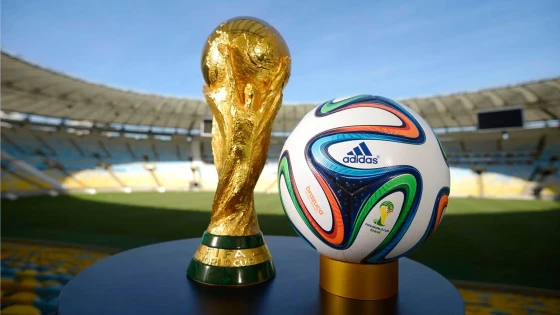
If we remember a little, you will remember that many players complained about the famous JABULANI, in the last World Cup. For this reason, Adidas spent a little more than two years correcting and improving the ball. The tests included wind tunnels and constant kicks from a robotic leg.
The technology integrated into the valve and casing is identical to that used in the Tango 12 of Euro 2012, the Cafusa of the 2013 FIFA Confederations Cup or the official ball of the UEFA Champions League. The structure of the new outer paneling and the unique symmetry of the six identical panels help to improve control and contact, as well as stability and aerodynamics on the field of play. In addition, even at high speeds, they favor control of the ball at all times.
The name of this new product will be BRAZUCA and they say that it was tested by at least 600 professional soccer players, 30 teams from ten countries spread over three continents, which makes it the adidas ball that has carried out the most tests in the history of the brand, the comments being very positive.
Solar energy, a contribution to the ecological.
The government of Rio de Janeiro Janeiro and the company Yingli Solar installed 1,500 solar panels on the roof of the Maracaná. Something similar, in the Mineirão Stadium in Belo Horizonte, which will also use solar energy. In the latter, the surplus energy will be used to bring electricity to approximately 400 houses near the stadium.
Ultra High Definition Filming (4K).
Sony will film three of the matches in ultra high definition, four times higher than standard HD. What is 4K? The name derives from the horizontal resolution, which is approximately 4,000 pixels, represented this way, because there are numerous aspect ratios used for filming. The horizontal resolution remains constant, while the vertical resolution depends on the aspect ratio with which you decide to work.
The chosen matches:
- One of the round of 16 matches, on June 28
- One of the quarterfinal matches, on July 4
- The final on July 13.
Sony will try to give a global boost to this technology, which although it is quite a bit recent has not yet managed to gain the momentum they expect.
With the end of the tournament, a promotional film will be produced that will include fragments of the matches filmed in 4K.
Live transmission through gadgets for mobile devices.
The official FIFA application will allow you to watch the matches on smartphones and tablets; In addition to this, you can view results, news and information about each team, information about venues and stadiums, among other data.
Security through the use of aerial drones.
During each sporting event, Hermes 900 drones will patrol the sky commanded by the Brazilian Air Force and will join the Hermes 450 unmanned aircraft that they already use for control from the air.
4G, Guarantee of communication
Brazil is betting big and is preparing to invest 111 million dollars to achieve 4G coverage in all the cities and states that host the World Cup. The NEC firm actively participates in this race to innovate and aims for all communications during the competition to be via IP to, thus, rule out any analog route as far as communications are concerned.